
The AI Productivity Paradox: Why Your "Smart" Tools Are Making You Dumber (and How to Fix It)
Synthalyst Team
Synthalyst Team
We're living in the age of AI-powered productivity. Every day, new tools promise to automate, optimize, and supercharge our workflows. Yet, for many, the reality is a paradox: more AI tools often lead to more complexity, more distractions, and a creeping sense that we're losing our edge to the very technology designed to empower us.
This isn't another hype piece about AI's potential. This is a contrarian guide to navigating the AI productivity landscape, designed for the discerning professional who suspects that simply adding more AI isn't the answer. We'll expose the hidden pitfalls of uncritical AI adoption and provide a battle-tested framework to truly unlock AI's transformative power, turning it into your strategic co-pilot, not a digital babysitter. Prepare to reclaim your cognitive sovereignty.
The Illusion of Efficiency: When AI Becomes a Crutch – A Cautionary Tale
Meet Alex, a driven project manager. His inbox is overflowing, his calendar is a war zone, and he's constantly chasing deadlines. He hears about AI tools that promise to automate tasks, summarize meetings, and even draft emails. Eagerly, he adopts them all. Initially, there's a rush of efficiency. Tasks are completed faster, reports are generated in seconds. But soon, a subtle shift occurs. Alex finds himself skimming AI-generated summaries instead of deeply understanding the nuances. He relies on AI to draft his responses, and his own writing voice begins to fade. He's faster, yes, but is he smarter? Is he truly more productive, or just faster at shallow tasks?
The promise of AI is seductive: offload mundane tasks, accelerate decision-making, and free up time for high-value work. But without a deliberate strategy, AI can become a crutch, fostering a dependency that erodes critical thinking and deep work. This post will challenge the conventional wisdom and show you how to leverage AI to cultivate genuine productivity, not just perceived efficiency. It's time to master the machine, not be mastered by it.
1. The Automation Trap: Reclaiming Your Cognitive Bandwidth – The Art of Deliberate Delegation
AI excels at automating repetitive tasks. This is its greatest strength, but also its most subtle trap. If you automate without understanding why a task exists or what insights it provides, you risk automating away valuable learning opportunities and critical oversight. It's like delegating your workout to a robot; you might get the job done, but you lose the muscle and the benefit.
The Strategic Shift: Automate the Process, Not the Insight
Instead of simply delegating tasks to AI, focus on automating the process of data collection and initial synthesis, while retaining human oversight for interpretation and strategic decision-making. This is about intelligent orchestration, not blind surrender.
Intelligent Scheduling Assistants (e.g., Motion): Don't just let AI book meetings; use it to analyze your calendar patterns and suggest optimal times for focused work, collaborative sessions, and even breaks. This turns automation into a tool for strategic time allocation, not just task offloading. Imagine your calendar not as a reactive schedule, but as a proactive partner in your productivity.
Smart Data Synthesis (e.g., NotebookLM, Elicit): Instead of manually sifting through mountains of reports, use AI to extract key insights, identify trends, and flag anomalies. But you remain the interpreter, the one who connects the dots and makes the strategic decisions. This ensures you maintain cognitive control while benefiting from AI's speed. You become the detective, and AI, your highly efficient assistant.
Custom AI Agents for Augmentation, Not Replacement: Platforms like Make and n8n allow you to build custom AI workflows. Focus on agents that augment your unique skills – for example, an AI that drafts initial marketing copy based on your brief, which you then refine and infuse with your creative flair. This preserves your unique value proposition, allowing you to scale your impact without diluting your essence.
2. The Information Overload Illusion: From Data Drowning to Insight Surfing – Navigating the Deluge
AI promises to cut through information overload, but often it just generates more information, faster. The real challenge isn't access to data; it's the ability to extract actionable insights. Without a critical filter, AI can lead to an illusion of understanding, where you're drowning in data but starved for wisdom. It's like having access to every book in the world but no librarian to guide you.
The Strategic Shift: Curate Your AI Inputs, Challenge Its Outputs
Define Your Information Diet: Before feeding data to AI, clearly define what insights you need. What decisions are you trying to make? What problems are you trying to solve? This focused approach prevents AI from generating irrelevant noise. Think of it as setting your GPS before you start driving; without a destination, you'll just wander.
AI as a “Second Opinion”: Use AI to analyze data and provide initial conclusions, but always treat its outputs as a starting point for your own critical thinking. Challenge its assumptions, cross-reference its findings, and apply your unique human judgment. AI can show you the map, but you decide the best route.
The “Insight Loop”: Implement a feedback loop where you evaluate the quality of AI-generated insights. Did they lead to better decisions? Did they save you time? Continuously refine your AI prompts and data sources based on real-world outcomes. This iterative process ensures your AI tools are always learning and improving, just like you.
3. The Communication Conundrum: From AI-Generated Text to Human Connection – The Art of Authentic Voice
AI writing assistants can generate emails, reports, and social media posts in seconds. This is undeniably efficient. However, over-reliance on AI for communication risks diluting your unique voice, fostering generic interactions, and ultimately weakening human connection. The goal isn't just to communicate faster; it's to communicate more effectively and authentically. Your voice is your fingerprint; don't let AI smudge it.
The Strategic Shift: AI as a “Thought Partner,” Not a Ghostwriter
AI for Ideation and Structure: Use AI to brainstorm ideas, outline arguments, and refine sentence structure. Let it handle the grunt work of drafting, but you inject the personality, the nuance, and the strategic intent. AI can build the house, but you furnish it with soul.
Voice Calibration: Train your AI tools on your own writing style to ensure consistency. But always review and edit to ensure the message sounds authentically you. Your unique voice is a competitive advantage; protect it fiercely.
The “Empathy Check”: Before sending any AI-generated communication, perform an empathy check. Does it resonate emotionally? Does it convey genuine understanding? AI can optimize for clarity, but human empathy is irreplaceable. A message might be grammatically perfect, but if it lacks heart, it falls flat.
4. The Learning Plateau: Re-Engaging Your Growth with AI-Powered Challenges – Your Personal Cognitive Trainer
AI can personalize learning paths and recommend resources. But passive consumption of AI-curated content can lead to a learning plateau, where you feel like you're learning but aren't actually growing. True growth comes from active engagement and challenging your existing knowledge. It's like having a gym membership but only ever watching others work out.
The Strategic Shift: AI as a “Personal Trainer” for Your Brain
AI-Generated “Stretch Assignments”: Use AI to create personalized challenges or simulations based on your learning goals. For example, if you're learning a new programming language, ask AI to generate a complex problem that forces you to apply multiple concepts. This transforms passive learning into active problem-solving.
The “Socratic AI”: Engage AI in a Socratic dialogue. Ask it to explain complex concepts, challenge its explanations, and debate its conclusions. This active questioning deepens understanding far more than passive reading. It forces you to think critically, not just absorb information.
AI for Skill Gap Identification: Regularly use AI to analyze your current skill set against industry demands. Ask it to identify your blind spots and suggest targeted learning interventions. This turns AI into a proactive career coach, guiding you to fill the gaps that truly matter for your growth.
5. The Strategic Integration Imperative: Beyond Tools to a System – Building Your AI-Augmented Operating System
Adopting a few AI tools won't transform your productivity. True AI-powered productivity comes from strategic integration – building a cohesive system where AI augments your unique human capabilities at every critical juncture. This isn't about AI replacing you; it's about AI making you irreplaceable. It's about designing an operating system where human and artificial intelligence work in seamless harmony.
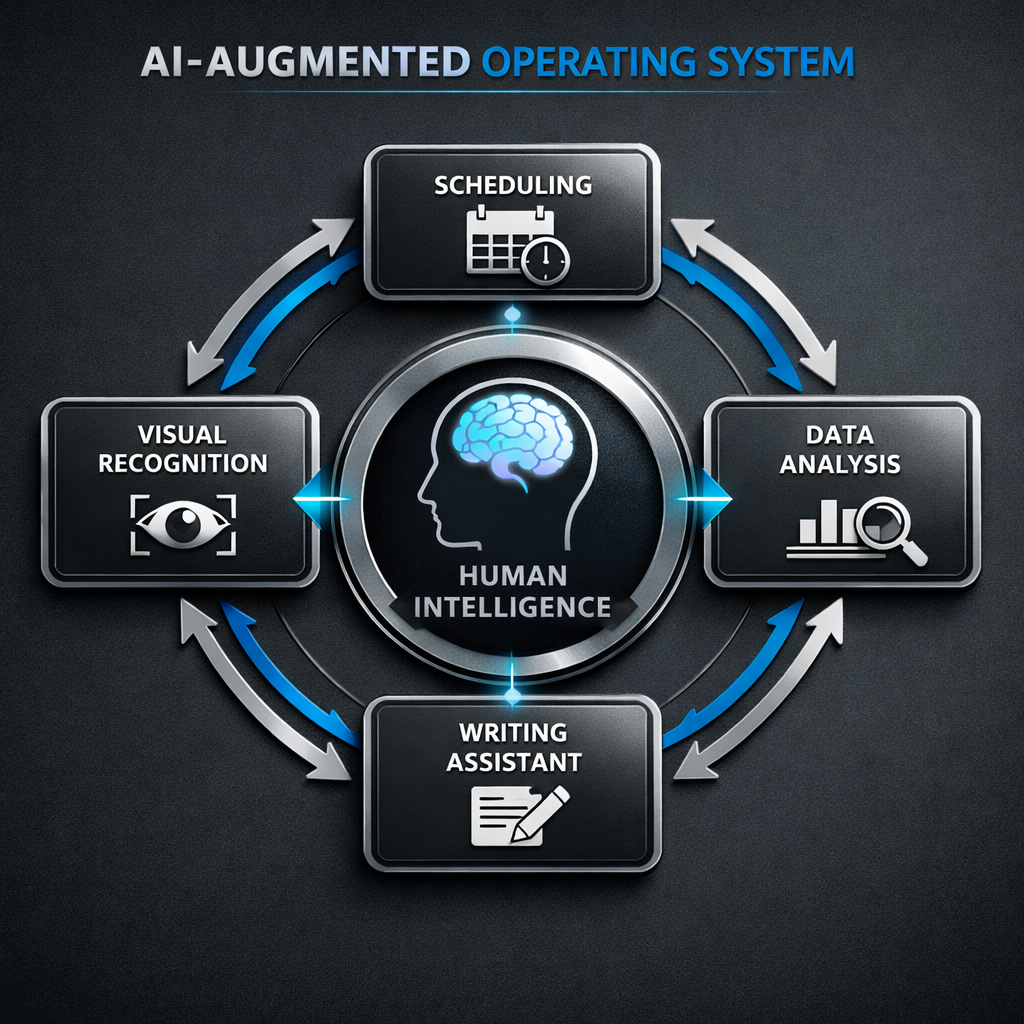
The AI-Augmented Operating System
The Strategic Shift: Design Your “AI-Augmented Operating System”
Conduct an “AI Audit” of Your Workflow: Map out your entire workflow and identify every point where AI can either automate a low-value task or augment a high-value decision. Prioritize interventions that free up your cognitive energy for creative and strategic work. Where can AI lift the burden, and where can it sharpen your edge?
Build Interconnected AI Workflows: Don't let your AI tools operate in silos. Use platforms that allow you to connect different AI services, creating seamless, end-to-end automation for complex processes. Think of it as building a sophisticated machine where each AI tool is a specialized gear, working together to achieve a grander purpose.
Continuous Optimization: The AI landscape is constantly evolving. Regularly review and optimize your AI-augmented operating system. What new tools are available? How can you further refine your prompts and workflows? This is an ongoing process of strategic adaptation, ensuring your system remains cutting-edge and effective.
Your Move: Conductor or Conducted?
The AI Productivity Paradox is not a trap; it's a crucible. It's forcing us to confront an uncomfortable question: are we shaping our tools, or are they shaping us?
The professionals who thrive won't be the ones with the most AI subscriptions. They'll be the ones who design their own human-AI operating system — deliberately, strategically, and on their own terms.
What's one aspect of your workflow where you suspect AI is quietly taking over rather than lifting you up? Share your war stories in the comments — the honest ones are always the most valuable.