
The Lifelong Learning Fallacy: Why Most Professionals Are Learning Wrong
Synthalyst Team
Synthalyst Team
We're told that lifelong learning is the key to a future-proof career. In a world where the World Economic Forum predicts 39% of core skills will be obsolete in the next five years, that advice seems sound [1]. Yet, for many, this mantra has become a treadmill — a relentless pursuit of certificates and courses that leaves them feeling busy, but not truly growing. We collect badges, passively consume content, and wonder why our careers aren't accelerating.
The truth is, most of what we call “learning” is actually just information hoarding. It's a feel-good activity that rarely translates into tangible growth. This isn't another generic list of tips. This is a contrarian framework designed to transform you from a passive information consumer into an active, strategic learner who builds real-world skills and undeniable career momentum. Prepare to challenge everything you thought you knew about learning.
The Core Problem: We Confuse “Learning” with “Knowing” – A Story of Stagnation
Imagine Sarah, a mid-career marketing manager. She's diligent, always signing up for the latest online courses in AI, data analytics, and digital strategy. Her LinkedIn profile is a testament to her commitment to lifelong learning. Yet, when a new, complex project lands on her desk, one that requires applying these cutting-edge skills, she freezes. She knows the theories, she's passed the quizzes, but she can't do. Her knowledge is a vast, unorganized library; her capability, a blank page.
We've been conditioned to believe that knowledge acquisition is the goal. We read books, watch lectures, and attend webinars, and we feel productive. But knowledge without application is trivia. The real goal is capability. Can you do something today that you couldn't do yesterday? If the answer is no, you haven't learned; you've only known. This distinction is the foundation of effective learning. The following five strategies are designed to bridge the gap between knowing and doing, transforming you from a knowledge hoarder into a skill architect.
1. Ditch Vague Goals for “Capability Quests” – Your Hero's Journey Begins
Generic goals like “learn Python” are the equivalent of saying “I want to travel.” They lack a clear destination, a compelling reason, and a map. Instead, frame your learning as a Capability Quest: a specific, project-based mission with a tangible outcome. Think of it as your personal hero's journey, where the dragon isn't a mythical beast, but a real-world problem you're equipped to solve.
Vague GoalCapability Quest (The Hero's Mission)“Learn about AI”“Build a simple AI-powered chatbot for my personal website by the end of the quarter, capable of answering FAQs about my services.”“Get better at marketing”“Launch and manage a profitable Google Ads campaign for a local business with a $500 budget, achieving a 2x ROI within three months.”“Improve my interview skills”“Complete 10 mock interviews using AI-powered interview prep and land a second-round callback within six weeks.”
Why this works: A quest is a story with you as the protagonist. It's inherently motivating, measurable, and directly tied to a real-world skill. It forces you to move beyond abstract theory and into the messy, valuable world of application. The narrative of your quest keeps you engaged, pushing you through challenges and celebrating milestones.
2. Escape the “Course Completion” Trap with a Multimodal Toolkit – Beyond the Textbook
Finishing an online course is not the finish line. It's the starting pistol. Relying on a single source of information is a recipe for shallow understanding. True mastery comes from a multimodal approach that surrounds you with diverse perspectives and formats. Imagine a master craftsman who only uses one tool; they're limited. A true master has a full toolkit, and knows when to use each instrument.
Deconstruct, Don't Just Consume: Instead of just reading a book, actively deconstruct its core arguments, challenge its premises, and map its concepts. Instead of just watching a video, try to replicate the results, pausing, experimenting, and taking notes. Engage with the material actively, as if you're preparing to teach it.
Build Your “Personal Board of Directors”: Curate a select group of 5-10 top experts in your target field. Follow them on social media, subscribe to their newsletters, and devour their podcast interviews. This creates a personalized, real-time learning feed that exposes you to cutting-edge thought and diverse viewpoints, far beyond the confines of a single course.
Join the Conversation: Don't just lurk in online communities. Ask probing questions, share your own projects (even the failures!), and provide constructive feedback to others. The OECD has highlighted that collaborative learning is a key skill for the future workforce [2]. This active participation transforms passive consumption into dynamic interaction, deepening your understanding and expanding your network.
3. The “Learn, Build, Teach” Flywheel – The Ultimate Skill Accelerator
This is the most powerful learning accelerator, a continuous loop that transforms knowledge into mastery. It's a three-step process that forces you to move from passive consumption to active creation, solidifying your understanding at each turn.
Learn: Acquire the foundational knowledge. This is the traditional input phase – reading, watching, listening. But do it with intent, always asking: How will I apply this? What problem will this help me solve?
Build: Immediately apply what you've learned to a real-world project, however small. This could be a personal project, a volunteer effort, or a stretch assignment at work. This is where abstract knowledge transforms into tangible skill. This is where the rubber meets the road.
Teach: Explain what you've learned and built to someone else. This could be a colleague, a mentee, a blog post (like this one!), or even a simple presentation. Teaching forces you to organize your thoughts, identify gaps in your understanding, and articulate complex concepts simply and clearly. It's the ultimate test of true comprehension.
Why this works: The act of teaching is the ultimate test of understanding. If you can explain a complex concept simply and clearly, you truly understand it. This flywheel creates a continuous loop of growth, where each stage reinforces the others, propelling you towards genuine expertise. It's a rhythmic dance between input, application, and articulation.
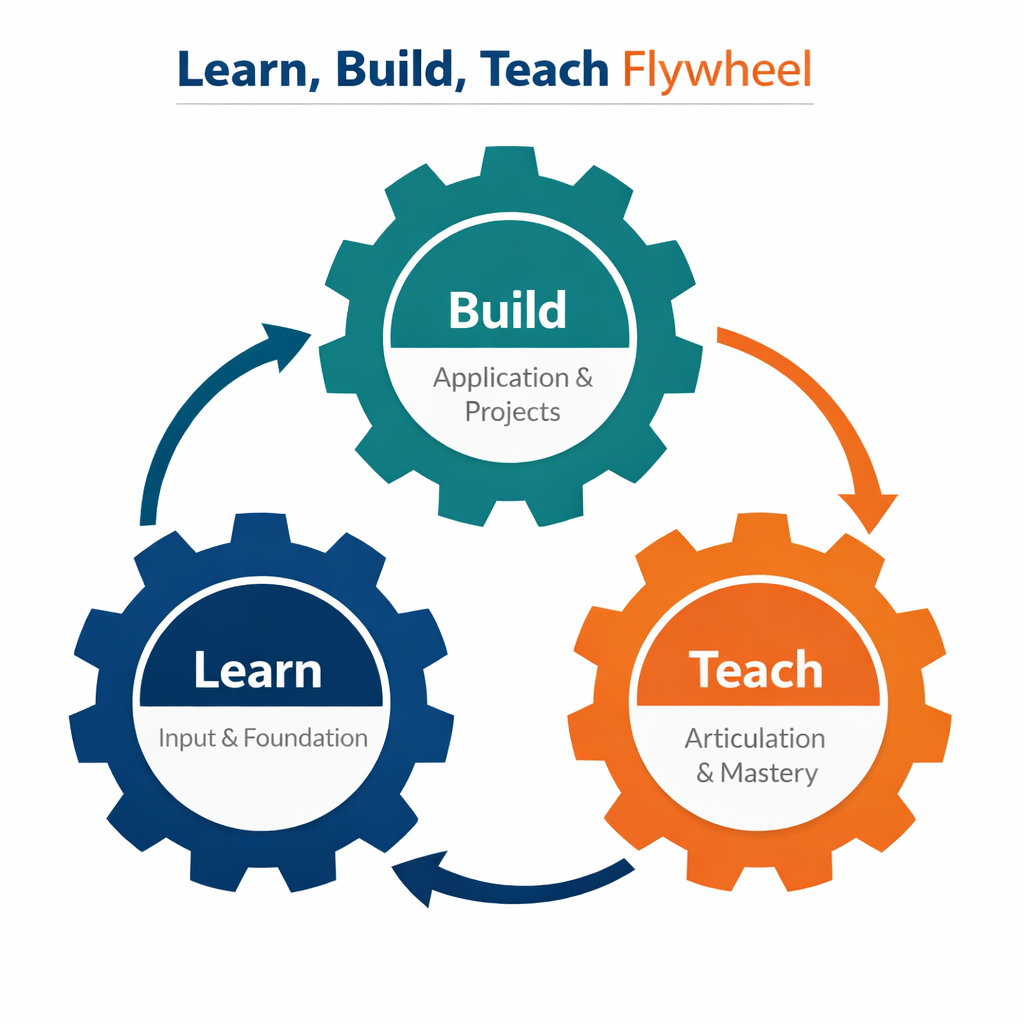
The Learn, Build, Teach Flywheel
4. Cultivate Your “Intellectual Sparring Partners” – The Forge of Ideas
Learning in isolation is slow and prone to blind spots. The most effective learners are part of a dynamic intellectual ecosystem. They actively seek out individuals who challenge their assumptions, offer diverse perspectives, and hold them accountable. Think of it as a mental dojo, where ideas are sharpened through respectful, rigorous debate.
The “Challenge Network”: Identify 2-3 individuals who are experts in areas you want to grow in. Don't just passively follow them; actively engage with their ideas, ask probing questions, and seek their feedback on your projects. These are the people who will push you beyond your comfort zone and expose you to new ways of thinking.
Cross-Pollinate Ideas: Actively participate in communities outside your immediate field. Breakthroughs often happen at the intersection of different disciplines. The OECD emphasizes the need for collaborative learning in a rapidly changing world [2]. By exposing yourself to different mental models, you unlock novel solutions to old problems.
Mentorship (Both Ways): Seek out mentors who have walked the path before you, but also be a mentor. Teaching others is a powerful way to deepen your own understanding, solidify your knowledge, and build your leadership skills. It's a virtuous cycle of giving and receiving wisdom.
Why this works: Your network is your net worth, and your intellectual network is your learning accelerator. Diverse perspectives expose you to new ideas, prevent intellectual stagnation, and provide the critical feedback necessary for true growth. It's the difference between practicing alone and training with a world-class team.
5. Embrace the “Productivity of Not Knowing” – The Edge of Innovation
In a world obsessed with knowing all the answers, the most powerful skill is the ability to comfortably and strategically embrace not knowing. This isn't about ignorance; it's about cultivating intellectual humility, a relentless curiosity, and the courage to venture into uncharted territory. It's at the edge of your knowledge that true innovation resides.
The “Beginner's Mindset”: Approach every new topic with the openness and curiosity of a beginner, even if you're an expert in related fields. This prevents arrogance, fosters genuine discovery, and allows you to see problems with fresh eyes, unburdened by preconceived notions.
Ask “Why Not?”: Challenge existing norms and assumptions. The greatest innovations often come from questioning the status quo. What if we did things differently? What if the accepted truth is actually a limiting belief? This critical inquiry is the engine of progress.
The “Learning Debt” Audit: Regularly assess your knowledge gaps. What are the critical skills or concepts you don't understand that are holding you back? Prioritize learning these, even if it feels uncomfortable. This proactive approach to addressing your intellectual blind spots is a hallmark of high-performers.
Why this works: True innovation and deep learning stem from a place of curiosity and a willingness to admit what you don't know. This mindset fosters continuous growth, prevents you from becoming complacent, and positions you at the forefront of new discoveries. It's the courage to be wrong that ultimately leads to being right.
The Real Question Nobody's Asking
Here's what keeps me up at night: we've built an entire professional development industry around the assumption that more learning = more growth. But what if the bottleneck was never knowledge at all? What if it was always courage — the courage to build before you're ready, to teach before you feel like an expert, to admit what you don't know in a culture that rewards certainty?
What's one thing you've been “learning about” for months that you've never actually built anything with, and what's really stopping you? The comments are open. Be honest.
References
World Economic Forum. (2025). Future of Jobs Report 2025. Link
OECD. (2025). OECD Skills Outlook 2025. Link
Cornerstone OnDemand. (2025). 8 reasons why continuous learning is crucial for career growth. Link
Percolator. (2025). Career Resilience in 2025: Building a Future-Proof Workforce. Link
BCJobs.ca. (2025). Lifelong Learning: Staying Ahead in 2025 and Beyond. Link


