
The Virtual Interview Trap: Why Your 'Best' Advice Is Costing You Jobs (and How to Actually Win)
Synthalyst Team
Synthalyst Team
Virtual interviews are here to stay. We all know the standard advice: test your tech, find a quiet space, dress professionally. But here's the uncomfortable truth: following that generic advice is no longer enough to stand out. In a hyper-competitive job market, where every candidate is doing the bare minimum, your “best” efforts might actually be costing you the job. It's a subtle trap, and most professionals don't even realize they're falling into it.
This isn't another rehash of common-sense tips. This is a contrarian guide designed for the ambitious professional who wants to move beyond merely participating in a virtual interview to dominating it. We'll expose the subtle mistakes even experienced candidates make and provide a five-point framework to transform your virtual presence from forgettable to irresistible. Prepare to turn your webcam into your most powerful career asset.
The Illusion of Preparation: When “Ready” Isn't Good Enough – A Story of Missed Opportunities
Imagine David, a talented software engineer. He's technically brilliant, but his virtual interviews consistently fall flat. He meticulously checks his internet, ensures his room is tidy, and even practices his answers. Yet, he never gets past the final round. Why? Because while he's prepared for the interview, he hasn't engineered the experience. His background is bland, his eye contact is off, and his voice lacks the subtle inflections that convey confidence. He's ready to participate, but not ready to win.
Most candidates believe they're prepared if their Wi-Fi works and their background is tidy. But true preparation goes deeper. It's about engineering an experience that captivates your interviewer, builds genuine rapport through a screen, and leaves an indelible impression. Are you truly ready to win, or just ready to participate? This post will challenge your assumptions and equip you with the advanced strategies needed to convert virtual interviews into job offers. It's time to stop hoping for the best and start orchestrating your success.
1. Beyond the Background: Engineer Your Digital Stage – Your Personal Broadcast Studio
Your virtual environment is not just a backdrop; it's a strategic extension of your personal brand. Generic virtual backgrounds or cluttered home offices are missed opportunities. Think of it as your personal broadcast studio, where every element is intentionally designed to enhance your message and presence.
The Strategic Shift: From Passive Background to Active Stage Management
Lighting is Non-Negotiable: Invest in a simple ring light or position yourself facing a window. Shadows obscure your face, making you appear less trustworthy and engaged. Your face should be evenly lit, bright, and clear, signaling professionalism and confidence. This isn't vanity; it's strategy.
Sound is Paramount: A high-quality microphone (even a simple lavalier mic) can dramatically improve your presence. Poor audio quality is distracting and signals a lack of attention to detail. Test it rigorously. Imagine trying to listen to a brilliant speaker through a crackling phone line — their message is lost. Don't let that be you.
The “Power Angle”: Position your camera slightly above eye level, looking slightly down at you. This is a subtle psychological trick that conveys authority and confidence. Avoid looking up at your camera, which can make you appear less assertive. It's about commanding the virtual space.
Minimize Digital Clutter: Close all unnecessary tabs and applications. Notifications are a death knell for focus, both yours and your interviewer's. Your screen should be as clean as your physical background, demonstrating your meticulousness and respect for their time.
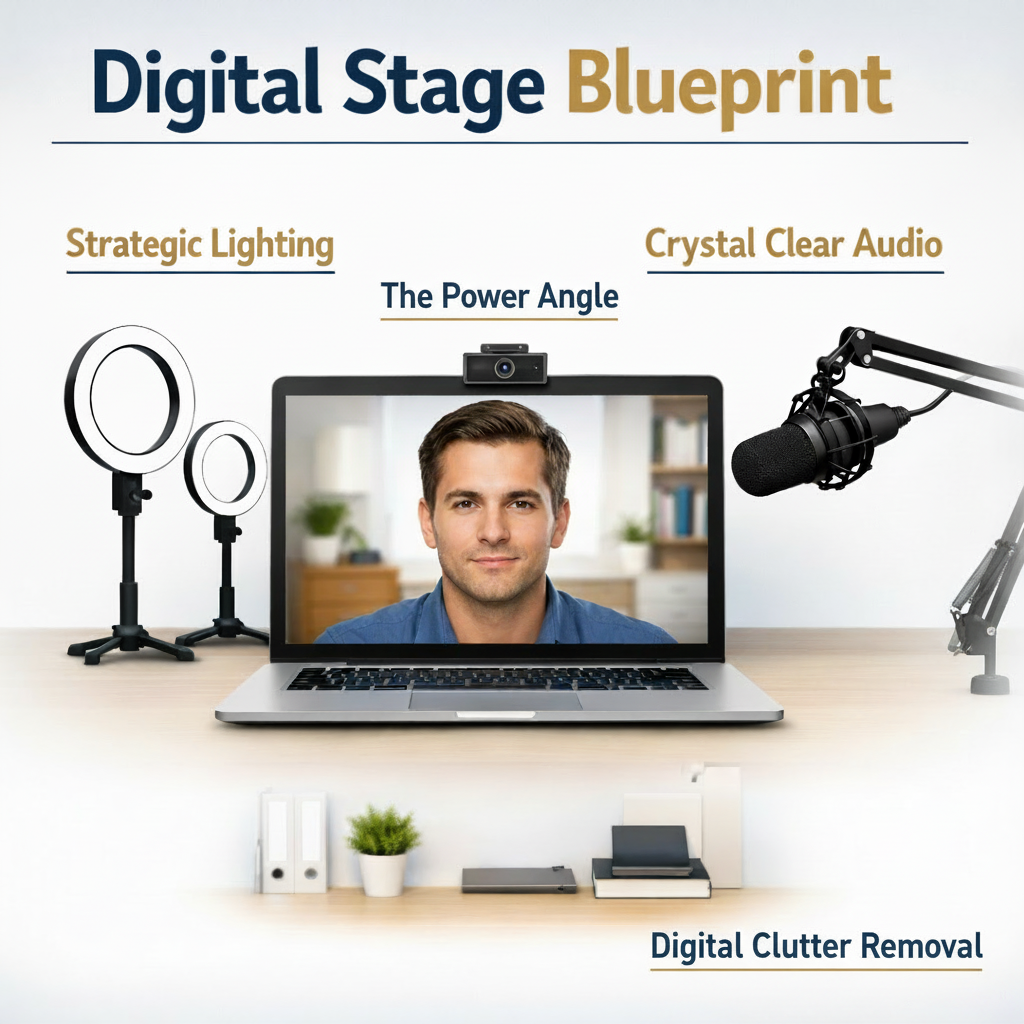
The Digital Stage Blueprint
2. The Unseen Language: Mastering Virtual Body Language – Projecting Presence Through Pixels
In a virtual setting, non-verbal cues are amplified. Your posture, gestures, and eye contact are under intense scrutiny. Most candidates fail to adapt their physical presence for the camera, losing impact. It's like trying to shout through a whisper; your message gets lost in translation.
The Strategic Shift: Exaggerate for Impact, Calibrate for Authenticity
Direct Eye Contact (with the Lens): This is the single most critical factor. Look directly into your camera lens when speaking, not at the interviewer's face on your screen. This simulates genuine eye contact and builds connection. Practice this until it feels natural. It's the closest you can get to a real handshake through the screen.
Purposeful Gestures: Keep your hands visible and use gestures to emphasize points, but avoid excessive or distracting movements. Your gestures should be slightly larger than in-person to register effectively on screen. Think of it as conducting an orchestra; every movement has a purpose.
The “Lean-In” Effect: Periodically lean slightly forward towards the camera. This subtle movement conveys engagement and enthusiasm. Combine it with direct eye contact for maximum impact. It signals, “I am fully present and invested in this conversation.”
Posture of Power: Sit upright, shoulders back. A confident posture not only looks better but also helps you feel more confident. It projects an image of capability and self-assurance, even if you're battling nerves.
3. The AI Advantage: Your Secret Weapon for Interview Mastery – Data-Driven Confidence
While others are still practicing with friends, you can leverage AI to gain an unfair advantage. AI-powered interview tools provide objective, real-time feedback that human coaches simply cannot match. This isn't cheating; it's smart preparation, turning your practice into a data-driven optimization process.
The Strategic Shift: From Mock Interviews to Data-Driven Optimization
Personalized Question Generation: Use tools like Synthalyst Interview Prep to generate role-specific and industry-tailored questions. This moves beyond generic behavioral questions to prepare you for the actual challenges of the role. It's like having a personalized exam prep coach who knows exactly what questions will be on the test.
Real-time Feedback on Delivery: Practice your answers and get instant analysis on your pacing, filler words, tone, and even facial expressions. This data-driven feedback allows for rapid iteration and improvement. Imagine a coach who can tell you, second by second, exactly where you can improve.
Sentiment Analysis: Some advanced AI tools can analyze the sentiment of your responses, helping you refine your emotional intelligence and ensure your message lands as intended. Are you coming across as confident, empathetic, or hesitant? AI can tell you.
Progress Tracking: Record your sessions and track your improvement over time. This objective data is invaluable for identifying weaknesses and celebrating progress. It transforms your interview preparation from guesswork into a measurable, iterative process.
4. Beyond Answers: The Art of the Virtual Conversation – Building Bridges Through the Screen
An interview is a two-way conversation, not an interrogation. Most candidates focus solely on delivering perfect answers, missing the opportunity to build rapport and demonstrate genuine curiosity. This is where the human element shines, and where you can truly differentiate yourself.
The Strategic Shift: From Answering Questions to Leading the Dialogue
Strategic Questioning: Prepare insightful questions that demonstrate your understanding of the company, the industry, and the challenges of the role. Ask questions that invite the interviewer to share their perspective, not just provide factual information. This shows you're not just looking for a job, but a meaningful contribution.
Active Listening & Bridging: Don't just wait for your turn to speak. Actively listen to the interviewer's responses, acknowledge their points, and then bridge to your own experiences or insights. “That's an interesting point about X, and it reminds me of a time when I…” This creates a natural, flowing conversation, making the interview feel less like an interrogation and more like a collaboration.
The “Follow-Up Question” Power Play: When an interviewer asks if you have any questions, don't just ask one. Have 2-3 prepared, and be ready to ask follow-up questions based on their answers. This shows genuine engagement and intellectual curiosity, leaving a lasting impression of thoughtfulness.
5. The Post-Interview Power Play: Crafting an Unforgettable Follow-Up – The Final Impression
Your interview isn't over when the video call ends. The follow-up is your final opportunity to reinforce your value, address any lingering doubts, and leave a lasting impression. Most candidates send a generic thank-you email. You won't. You'll use this as a strategic opportunity to seal the deal.
The Strategic Shift: From Courtesy to Conversion
The “Value-Add” Thank You: Instead of just thanking them for their time, reiterate a key point from your discussion and, if possible, provide a small, relevant piece of additional value. This could be a link to a project you discussed, an article related to their challenge, or a brief insight. This demonstrates your continued engagement and proactive mindset.
Address Weaknesses (Subtly): If there was a question you felt you didn't answer perfectly, this is your chance to subtly address it. “Reflecting on our conversation about X, I wanted to add that my experience in Y would also be highly relevant.” This shows self-awareness and a commitment to excellence.
Reiterate Fit with Specificity: Don't just say you're interested. Explain why you're a perfect fit, referencing specific aspects of the role or company culture discussed. This reinforces your alignment and passion for the opportunity.
The “Next Steps” Confirmation: Politely confirm the next steps in the hiring process and express your eagerness for the opportunity. This demonstrates your professionalism and keeps the momentum going.
The Uncomfortable Truth About Virtual Interviews
Here's what nobody talks about: the candidates who win virtual interviews aren't the most qualified, they're the ones who understood that a video call is a performance medium, not a conversation medium. They treated it like a craft to be mastered, not a chore to survive.
The gap between “prepared” and “engineered” is where jobs are won and lost. And that gap is only widening.
What's the single most overlooked aspect of virtual interviews that you believe gives candidates an unfair advantage? Drop your hard-won insights in the comments — especially the ones that feel counterintuitive.
References
Indeed. (2025). How To Make a Good Impression in a Virtual Interview. Link
Linkjob.ai. (2025). 5 Most Mind-Blowing AI Interview Tools of 2025 You've Never Tried. Link
Skillmint.ai. (2025). AI Interview Tools 2025: How to Use AI in Hiring for Better Decisions. Link
Smartmentor.ai. (2025). Complete Guide to AI-Powered Interview Preparation in 2025. Link
Thita.ai. (2025). Best AI Interview Prep Tools 2025 | Compare Top Platforms. Link
LinkedIn. (2026). Do AI Interview Prep Tools Work in 2026?. Link


